


Make No Bones
by Maggie Genoble

Center for the Arts | Dalton Gallery
121 E. Main St. Rock Hill, SC
EXHIBITION
July 31 - September 4, 2026
RECEPTION
Thursday, August 27, 2026
5:30 - 7:30 PM
GALLERY HOURS
Monday - Saturday
10 AM - 4 PM
SPONSORED BY
O'Darby's Fine Wine & Spirits
Rock Hill Coca-Cola
Bottling Company
PERIMETER GALLERY
Tone Deaf, works by Donald Medley
EXHIBITION | July 31 - September 4, 2026
RECEPTION | August 27, 2026 | 5:30 PM
EXHIBITION STATEMENT
Donald Medley’s work focuses on representing African Americans; figurative subjects that render themselves through an abstract space. Medley explores the ways that a space can inform and simultaneously hide how someone is seen. The environment that the subjects exist in overlap in certain places within the composition conveying the influence or imposing nature of a space. His work speaks to the larger context of black identity. This is in regards to how one expresses themselves considering the different spaces they have to enter and engage with. His work highlights the monolith in which black individuals are often contextualized, and depicts a surreal experience around their identity.

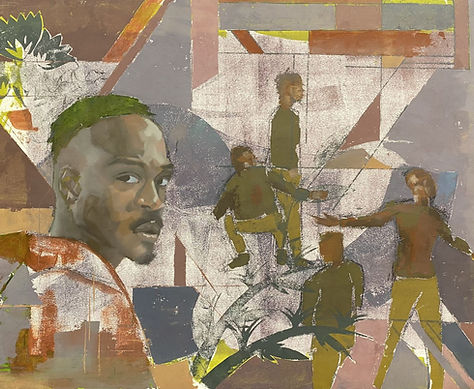
ARTIST BIO
Donald Medley is a South Carolina based artist who recently received his BFA from Converse University in May 2025. During his time at Converse, he has been able to use painting and printmaking to build a body of work. This work has been featured in multiple exhibitions and shows as well as received many awards. Among these include Buckham Gallery’s “Press Play” Juried Exhibition in Flint, M.I., the “Our People” exhibit in Fayetteville, N.C., the Judy and Bryant Bynum Award, the “Pots-n-Prints” exhibition at the University of Texas, the South Carolina Biennial, and Kai Lin Art’s “The New South 7” in Atlanta G.A.
He attended Converse at a pivotal time when they went co-ed, being one of the first classes of males. Coming to a previously all female school, Medley was a part of a smaller demographic in his current community. This led to an awareness of his Blackness and how it is perceived. Exploring these questions, Donald Medley has developed a solo exhibition around these themes. He continues to explore and communicate the dimensions in which people can exist in; particularly pertaining to people of color.

CLASSROOM GALLERY
Handarbeit: Instruments of Repair, works by Jamie Johnson
EXHIBITION | July 31 - September 4, 2026
RECEPTION | August 27, 2026 | 5:30 PM
EXHIBITION STATEMENT
Handarbeit: Instruments of Repair is a selection of sculptural textile works from Johnson's ongoing thesis project exploring mending, health, and consumption through Handarbeit (handwork). Using discarded clothing and fabric scraps, she reconstructs familiar medical objects, including scissors, a hand sanitizer bottle, a stethoscope, a scalpel, and a bandaid, as soft, non-functional forms.
Many of these objects are scaled to her own body or enlarged beyond their everyday proportions, shifting their presence from practical tools to sculptural objects. Altering their size encourages viewers to reconsider their familiarity and the emotional weight they carry within clinical spaces. Drawing from her own experiences with surgery and hospitalization, the work aims to highlight health, labor, and care while incorporating sustainability within my practice.
Through Handarbeit and reclaimed materials, these sculptures position mending as both a physical and symbolic act. By giving discarded textiles new purpose, the work challenges cycles of consumption while emphasizing repair as an ongoing process rather than a finished outcome. The exhibition invites viewers to consider healing not as a return to wholeness, but as a continuous practice shaped by memory, maintenance, and the labor of care.
ARTIST BIO
Jamie Johnson is a 25-year-old artist currently pursuing a Master of Fine Arts at Winthrop University. She graduated from the University of Mobile with a Bachelor of Fine Arts in Graphic Design in December 2024. While sculpture is the primary focus of her current practice, she also works with sewing, embroidery, knitting, weaving, crocheting, painting, ceramics, and drawing. She enjoys combining different materials and techniques and is always interested in exploring new ideas and processes.
Johnson's practice is rooted in sustainability, material reuse, and the traditions of Handarbeit (handwork). She was born in Germany, where she was surrounded by a culture that values recycling, repairing, and reducing waste. From a young age, her mother and her Oma (grandmother) taught her Handarbeit techniques such as sewing and knitting, encouraging her to value both craftsmanship and the longevity of materials. These experiences continue to shape the way she approaches making today. Johnson is drawn to reusing and repurposing discarded textiles, finding new life in materials that might otherwise be thrown away.
Johnson is also interested in roadways, maps, and healthcare, particularly how systems of support shape our daily lives and experiences. These interests emerge in my work through themes of navigation, repair, vulnerability, and resilience. By combining Handarbeit techniques with sculpture and mixed media, she creates work that reflects personal experience while encouraging conversations about care, healing, sustainability, and our relationship with the materials we use and discard.

CALL FOR PRIVATE VIEWINGS
(803) 328-2787